-
The Algebra’s Apprentice: Prelude – Part II
In The Algebra’s Apprentice: Prelude – Part I, I shared how my initial approach to learning about physics changed from one of awe and reverence to skeptical inquiry. This is the latter half of the prelude, wherein I will tell you the story of how I came to meet a most mysterious algebra. A Shape… Continue reading →
-
The Algebra’s Apprentice: Prelude – Part I
In “The Algebra’s Apprentice” posts I begin writing here, I intend to faithfully tell the story of how I met Macfarlane’s algebra and the journey I have been on ever since. This is an ongoing work in progress, a way to share the narrative arc of a still unfolding exploration. A Quantum of Curiosity That… Continue reading →
-
On the Insufficiency of Groupoids
Macfarlane’s hyperbolic quaternions are the source of unresolved mystery yet again. Idempotents play havoc with invertibility and give groupoids the boot. Continue reading →
-
The Emperor’s New Closure
This playful notebook entry is a story that came to mind after a very real algebraic surprise I ran into while working with matrix representations. Posh Properties There once was an algebra that loved to try on matrix representations. It seemed of a reasonable and regal character, governing by simple laws and properties. While the… Continue reading →
-
Closure Note
Definition Reminder A hyperbolic quaternion (Macfarlane non-associative variety) is a linear combination of the elements \(\lbrace 1, i, j, k \rbrace\) using real coefficients such that \[q = q^0 1 + q^1 i + q^2 j + q^3 k, \quad q^0, q^1, q^2, q^3 \in \Re. \] Multiplication is defined according to the following rules:… Continue reading →
-
The Compass and the Gyre
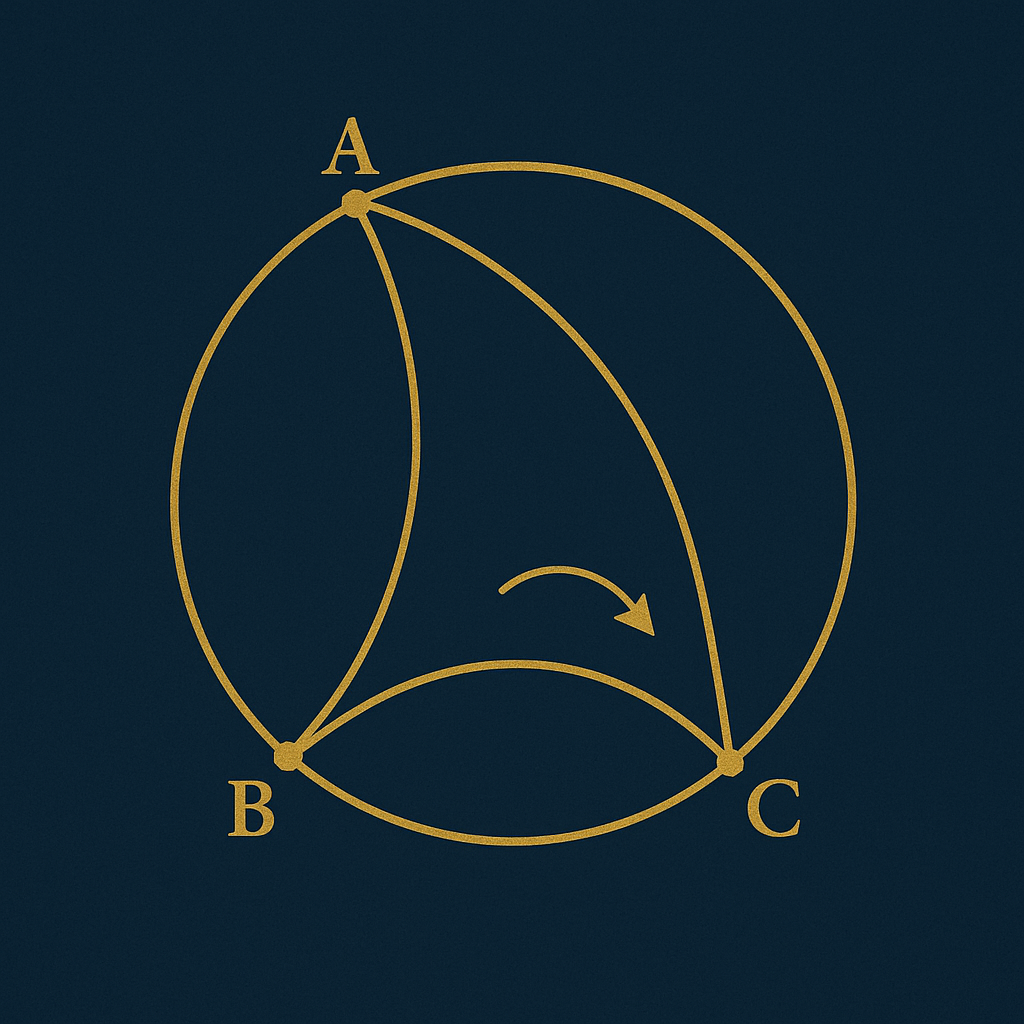
When gyrovector spaces and hyperbolic quaternions brush against one another, their shared symmetries shimmer — and richer geometric structures stir just beneath the surface. Continue reading →
-
Hyperbolic Quaternions

An introduction to Macfarlane’s hyperbolic quaternions, a quaternionic algebra whose chiral multiplication reveals a direct basis for the Lorentz generators. A primer on their structure, pathologies, and connection to spacetime symmetries. Continue reading →